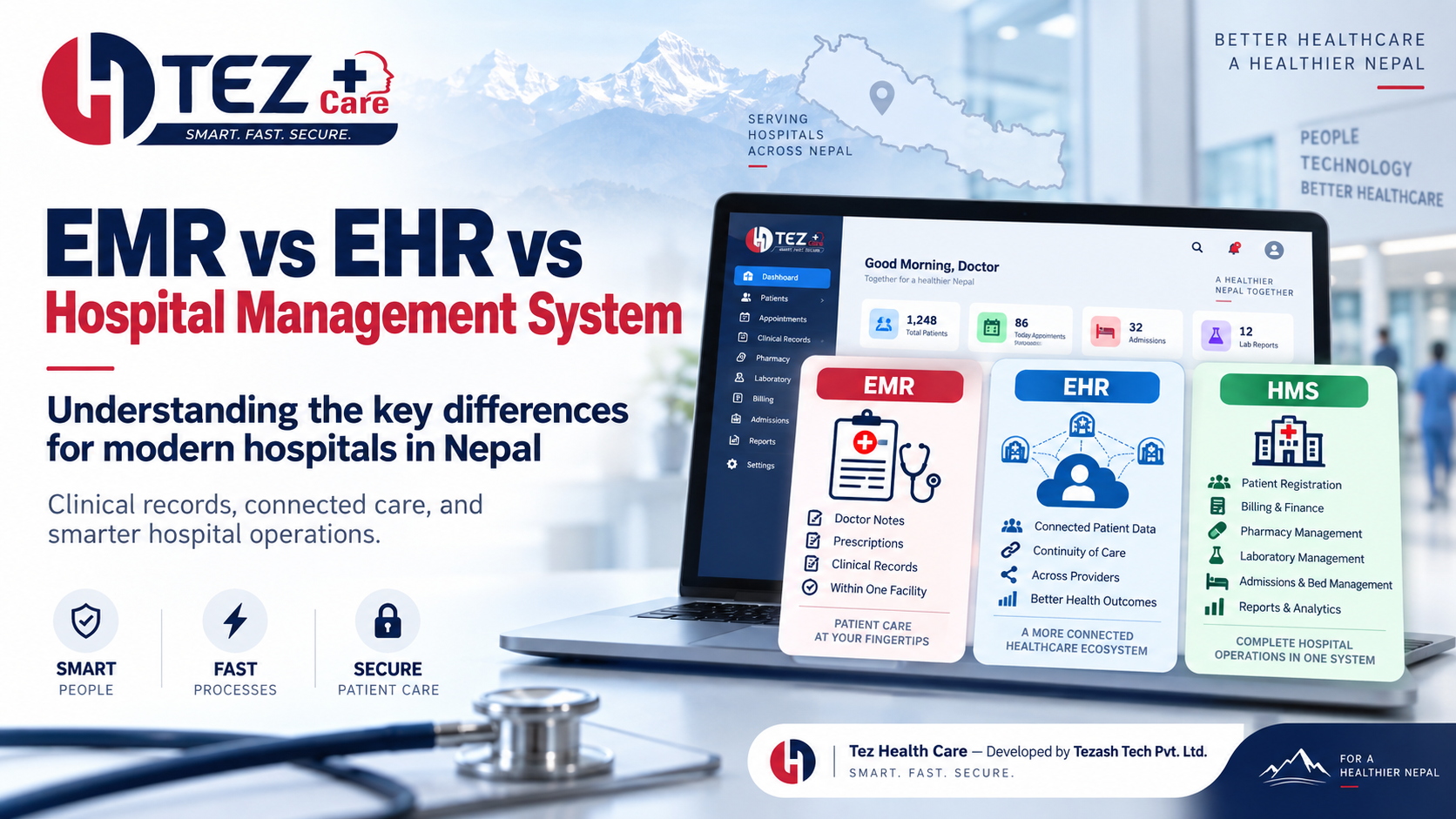
Healthcare technology uses many similar terms, and EMR, EHR, and Hospital Management System (HMS) are often confused with one another.
They are related, but they are not the same.
Understanding the difference is important for hospitals, clinics, and healthcare organizations that are planning to digitize their operations.
What Is an EMR?
An Electronic Medical Record (EMR) mainly focuses on a patient’s clinical information inside a healthcare organization.
It may include:
- Doctor notes
- Diagnosis
- Prescriptions
- Vital signs
- Allergies
- Investigation results
- Medical history
- Follow-up information
An EMR helps doctors and clinical teams maintain a digital patient record instead of relying only on paper files.
In simple terms:
EMR = Digital clinical record of the patient within a healthcare facility.
What Is an EHR?
An Electronic Health Record (EHR) is broader than an EMR.
An EHR is designed to provide a more complete view of a patient’s health information and may support sharing or continuity of records across different healthcare providers or systems when proper interoperability is available.
It can contain information such as:
- Previous medical history
- Diagnoses
- Prescriptions
- Laboratory reports
- Imaging reports
- Allergies
- Treatment history
- Records from different healthcare providers
In simple terms:
EHR = A broader, more connected digital health record.
What Is a Hospital Management System?
A Hospital Management System (HMS) manages the overall operations of a hospital.
While EMR and EHR mainly focus on patient health information, an HMS also manages administrative, financial, and operational activities.
A Hospital Management System can include:
- Patient Registration
- OPD
- IPD
- Emergency
- EMR
- Laboratory
- Radiology
- Pharmacy
- Billing
- Insurance
- Inventory
- Appointment Management
- Accounting and Reports
- User Roles and Permissions
In simple terms:
HMS = The complete operational system used to manage a hospital.
EMR vs EHR vs HMS
| System | Main Purpose | Typical Use |
|---|---|---|
| EMR | Clinical patient records | Doctors and clinical teams |
| EHR | Broader connected health records | Continuity of care across providers |
| HMS | Complete hospital operations | Clinical, administrative, financial, and operational management |
The easiest way to understand the difference is:
EMR manages the medical record.
EHR connects the broader health record.
HMS manages the hospital.
Can a Hospital Management System Include EMR?
Yes.
A modern Hospital Management System often includes an EMR as one of its important modules.
For example, a patient may:
Register → Visit Doctor → Get Diagnosed → Complete Lab Tests → Buy Medicines → Make Payment
The EMR stores the clinical part of this journey.
The HMS connects the entire journey.
That includes registration, billing, pharmacy, laboratory, insurance, inventory, and reporting.
Why Integration Matters
Hospitals should avoid using separate systems that do not communicate with each other.
For example, if a doctor requests a laboratory test, the ideal workflow is:
- The doctor creates the request.
- The laboratory receives it.
- Billing records the service.
- The laboratory enters the result.
- The doctor can view the result.
- The result remains connected to the patient record.
This is much more efficient than entering the same information repeatedly in different systems.
Which System Does a Hospital Need?
Most hospitals need more than just an EMR.
An EMR can manage clinical information, but it does not automatically manage:
- Billing
- Pharmacy
- Bed management
- Inventory
- Insurance
- Financial reports
- Purchases
- Hospital operations
For a full hospital environment, an integrated Hospital Management System with EMR capabilities is usually more practical.
Tez Health Care: Connecting Clinical and Hospital Operations
Tez Health Care, developed by Tezash Tech Pvt. Ltd., is designed as a connected healthcare management platform.
It can bring together clinical and operational areas such as:
- Patient Registration
- OPD and IPD
- Emergency
- EMR
- Laboratory
- Radiology
- Pharmacy
- Billing
- Insurance
- Inventory
- Reports and Analytics
The goal is to avoid disconnected hospital workflows and create one integrated system around the complete patient journey.
Smart. Fast. Secure.
Why This Matters for Hospitals in Nepal
Many hospitals in Nepal are moving from paper-based or partially digital systems toward more integrated platforms.
The challenge is not simply converting records into digital form.
The bigger challenge is making sure different departments can work together.
A connected system can help improve:
- Patient service
- Clinical documentation
- Billing accuracy
- Pharmacy stock control
- Insurance workflows
- Reporting
- Department coordination
- Management visibility
Final Thoughts
EMR, EHR, and HMS all play important roles in healthcare technology.
The key difference is their scope.
EMR focuses on the patient’s clinical record.
EHR focuses on a broader and more connected health record.
Hospital Management System focuses on the complete operation of the healthcare organization.
For hospitals looking to digitize their operations, the best approach is usually not to choose one term over another, but to build an integrated system where clinical records and hospital operations work together.
Tez Health Care by Tezash Tech is built around that connected approach.
Continue reading
More practical insights

Tezash Tech Wins ICT Startup Award 2024 in Madhesh Province
We are thrilled to announce that Tezash Tech Pvt Ltd has been honored with the Best Startup Award from Madhesh Province at th...
Read article
Hospital Management System in Nepal: Complete Guide | Tez Health Care
Hospital Management System in Nepal: Complete Guide | Tez Health Care
Read article
Integrating AI in Our Software: Revolutionizing the Future of Technology
At Tezash Tech, we believe that the future of technology is driven by innovation and intelligence. With the rapid advancement...
Read article